Just Another Tutu
AI in Telemedicine Market: 2024–2032 Size, Share, and Industry Trends
AI in Telemedicine Market: 2024–2032 Size, Share, and Industry Trends
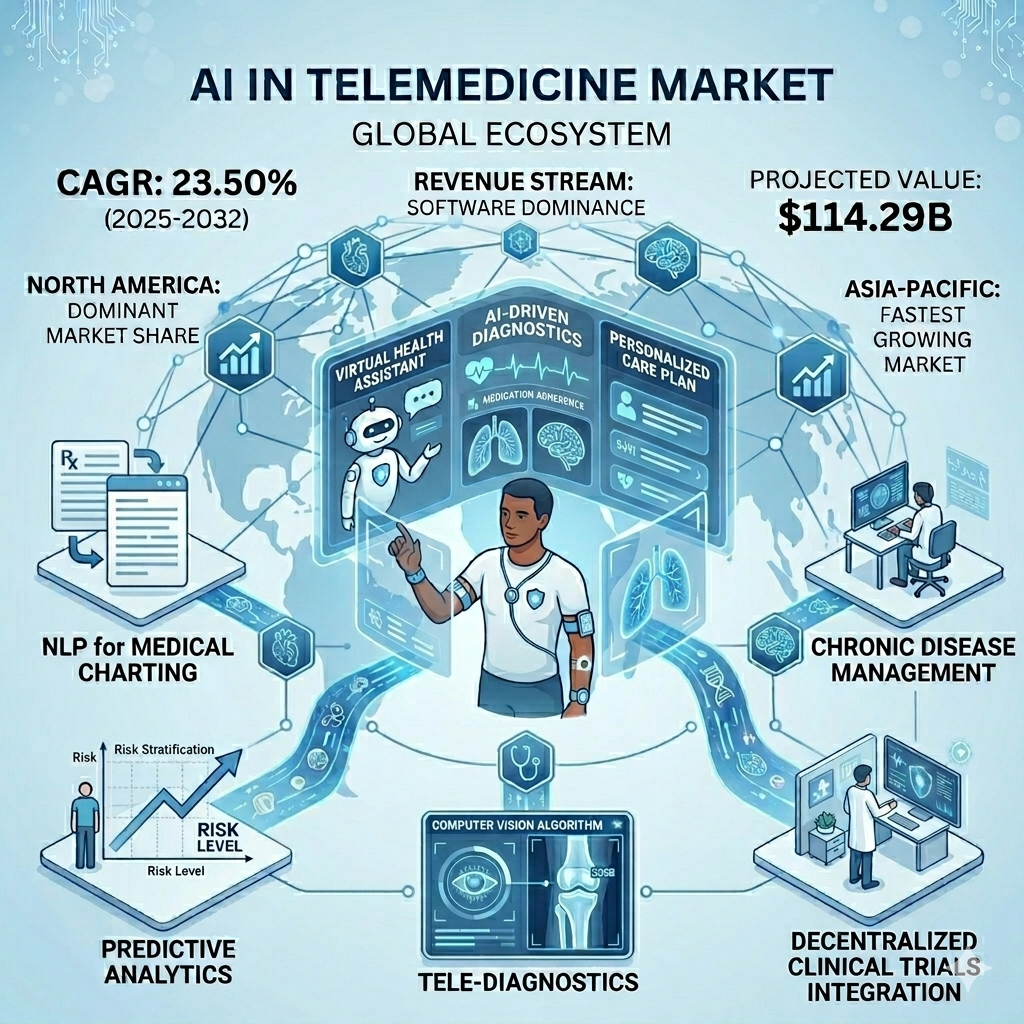
The global AI in telemedicine market is redefining the boundaries of digital healthcare. By moving beyond simple video consultations to AI-driven predictive care, the industry is addressing critical global challenges like physician shortages and rising chronic disease rates. According to the latest market intelligence, this sector is positioned for monumental growth through 2032.
DOWNLOAD THE AI MARKET SNAPSHOT (PDF)
Market Size and Exponential Growth Forecast
The Artificial Intelligence in telemedicine sector is one of the fastest-growing segments in the broader HealthTech landscape:
-
Market Value (2025): Estimated at USD 26.10 Billion.
-
Projected Market Value (2032): Expected to surge to USD 114.29 Billion.
-
CAGR: A robust 23.50% during the forecast period.
This growth is primarily driven by the transition from reactive healthcare to proactive remote patient monitoring (RPM) and the integration of machine learning into clinical workflows.
Top Drivers of AI Adoption in Telehealth
Why is the AI-powered telemedicine market expanding so rapidly? Key market drivers include:
-
Global Healthcare Workforce Shortage: AI acts as a "force multiplier," using automated triage and virtual assistants to alleviate the burden on exhausted medical staff.
-
Chronic Disease Management: With the rise of diabetes and cardiovascular issues, AI-driven wearable data analysis allows for continuous monitoring without hospital visits.
-
Operational Cost Reduction: Healthcare payers are prioritizing AI tools that prevent expensive emergency room readmissions through early intervention.
Market Segmentation: Software, Services, and Applications
By Component: The Software Dominance
The Software segment currently commands nearly 65% of the market share. This includes:
-
Natural Language Processing (NLP) for automated medical charting.
-
Computer Vision for remote dermatological and radiological diagnostics.
-
Predictive Analytics for patient risk stratification.
By Application: Remote Monitoring Takes the Lead
-
Remote Patient Monitoring (RPM): The largest application segment, utilizing AI to detect health anomalies in real-time.
-
Virtual Assistants & Chatbots: Streamlining the patient intake process and providing 24/7 basic medical guidance.
-
Tele-diagnostics: Leveraging AI to analyze high-resolution images sent from remote locations to specialists.
Regional Insights: North America vs. Asia-Pacific
-
North America: Remains the dominant market leader (~50% share) due to high healthcare IT spending and a mature regulatory environment for digital health.
-
Asia-Pacific: Identified as the fastest-growing region. Massive smartphone penetration in India and China, coupled with government-backed digital health initiatives, is fueling rapid adoption.
Strategic Challenges and Market Restraints
Despite the bullish outlook, industry stakeholders must navigate:
-
Data Security & Privacy: Ensuring strict compliance with HIPAA and GDPR while training AI models on sensitive patient data.
-
Interoperability: The difficulty of integrating new AI platforms with fragmented legacy Electronic Health Record (EHR) systems.
-
High Implementation Costs: The initial capital required for high-tier AI integration can be a barrier for smaller healthcare providers.
Conclusion: The Shift to "Telemedicine 2.0"
The report confirms that the market has evolved. We are no longer in the era of simple "video calls"; we have entered the age of intelligent, automated healthcare delivery. For investors and tech providers, the greatest opportunities lie in SaaS-based AI tools that seamlessly integrate into existing clinical pathways.
Couldn't load pickup availability